

House lawmakers this week got a first look at legislation for Kentucky’s road plan for 2026-2028, a $4.2 billion proposal for 617 projects across the state. Rep. Jason Petrie, chair of the House Appropriations and Revenue Committee, filed House Bill 502 Tuesday.
In a news release announcing the bill, Petrie said the road plan “is a strong response to the decline we’ve seen in gas tax revenue and ensures that every dollar has the best impact possible on Kentucky communities.”
HB 502 includes $420 million for pavement repairs on interstates and state highways, $900 million for bridge improvements, and continued funding for the Mountain Parkway, I-69, and Brent Spence Bridge mega projects.
Local Assistance Road Program
In addition to the state road plan, the House also released its proposal for county and city projects to receive funding in fiscal year 2027 through the Local Assistance Road Program (LARP). These projects are listed by county in House Joint Resolution 76.
The proposal includes $68.2 million for local road improvement projects rated an 8, 9, or 10 for repair condition.
This represents a substantial increase from current funding levels. LARP received $21.1 million in FY2026 and $20 million in FY2025. The proposed FY2027 funding exceeds those two years combined and would significantly expand the number of local roads eligible for resurfacing across the Commonwealth.
Since the program’s inception, funding levels have typically limited projects to roads rated a 10 — and occasionally a few rated 9 — in the statewide pavement condition system. The increased investment would allow more deteriorating roads to be addressed before conditions worsen further.
KACo appreciates House leaders recognizing the need for additional investment in local infrastructure and prioritizing funding for county road improvements.
County Road Aid falls short
While counties can look forward to a proposed increase in funding via the Local Assistance Road Program in the next budget, they are seeing the effects of a state revenue shortfall in the current fiscal year.
When counties received their second County Road Aid payment earlier this month, the amounts were significantly reduced following updated motor fuels tax revenue projections issued in December by the Consensus Forecasting Group (CFG).
Counties receive 18.3% of Kentucky’s motor fuels tax receipts through the county road aid revenue sharing program, the primary source of funding for maintaining county roads.
Kentucky’s motor fuels tax is adjusted annually based on the average wholesale price (AWP) of gasoline. When gas prices rise, the tax rate increases, and when prices fall, the rate decreases. Under this formula, the motor fuels tax declined from 27.8 cents per gallon (cpg) in FY2025 to 26.4 cpg in FY2026.
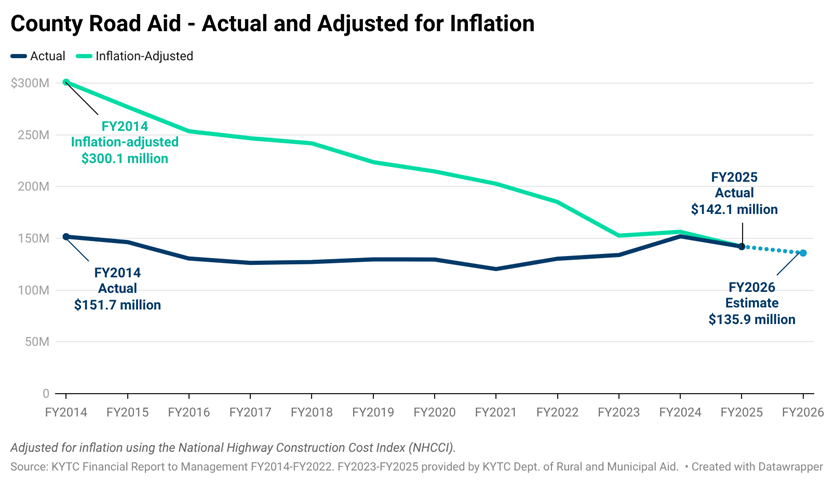
When the CFG met in December, it revised the motor fuels tax estimate downward. As a result, County Road Aid funding was reduced from the originally budgeted $157.3 million to $135.9 million, a projected decrease of more than $20 million.
This represents a substantial reduction in funds available to counties for maintaining and improving local roads.
County Road Aid payments
Most counties participate in the County Road Aid Cooperative Program administered by the Kentucky Transportation Cabinet’s Office of Rural and Secondary Roads.
Under the program, 3% of each participating county’s allocation is withheld and placed into an emergency fund, which counties may access in qualifying situations.
Counties in the cooperative program receive three annual payments rather than monthly distributions:
- 60% in the first installment
- 30% in the second installment
- A final payment based on actual revenues remaining at the close of the fiscal year
In FY2026, the first payment reflected 60% of the original $157.3 million estimate, totaling $94.4 million.
Following the CFG’s downward revision to $135.9 million, the second payment was reduced to 25% of the revised estimate, or $33.9 million. This adjustment was made to minimize the risk of overpayments given the reduced revenue outlook.
Rising costs and reduced revenues
The decline in County Road Aid is particularly concerning amid rapidly rising construction costs. The National Highway Construction Cost Index (NHCCI) has increased by roughly 90% over the past decade, meaning the cost of maintaining and improving infrastructure has nearly doubled.
At the same time, actual County Road Aid dollars are declining. Inflation alone means counties can resurface fewer miles of road each year while more roads fall into poor or failing condition. As rising construction costs combine with declining revenues, the maintenance backlog continues to grow.
The CFG also projected an additional 4.7% decline in motor fuels tax revenues for FY2027.
Taken together, these trends highlight the growing gap between infrastructure needs and available funding.
The proposed increase in LARP funding in the upcoming budget would provide important support to counties by allowing more deteriorating roads to be resurfaced before conditions worsen — helping offset, at least in part, the declining purchasing power of County Road Aid.